Magic: The Gathering
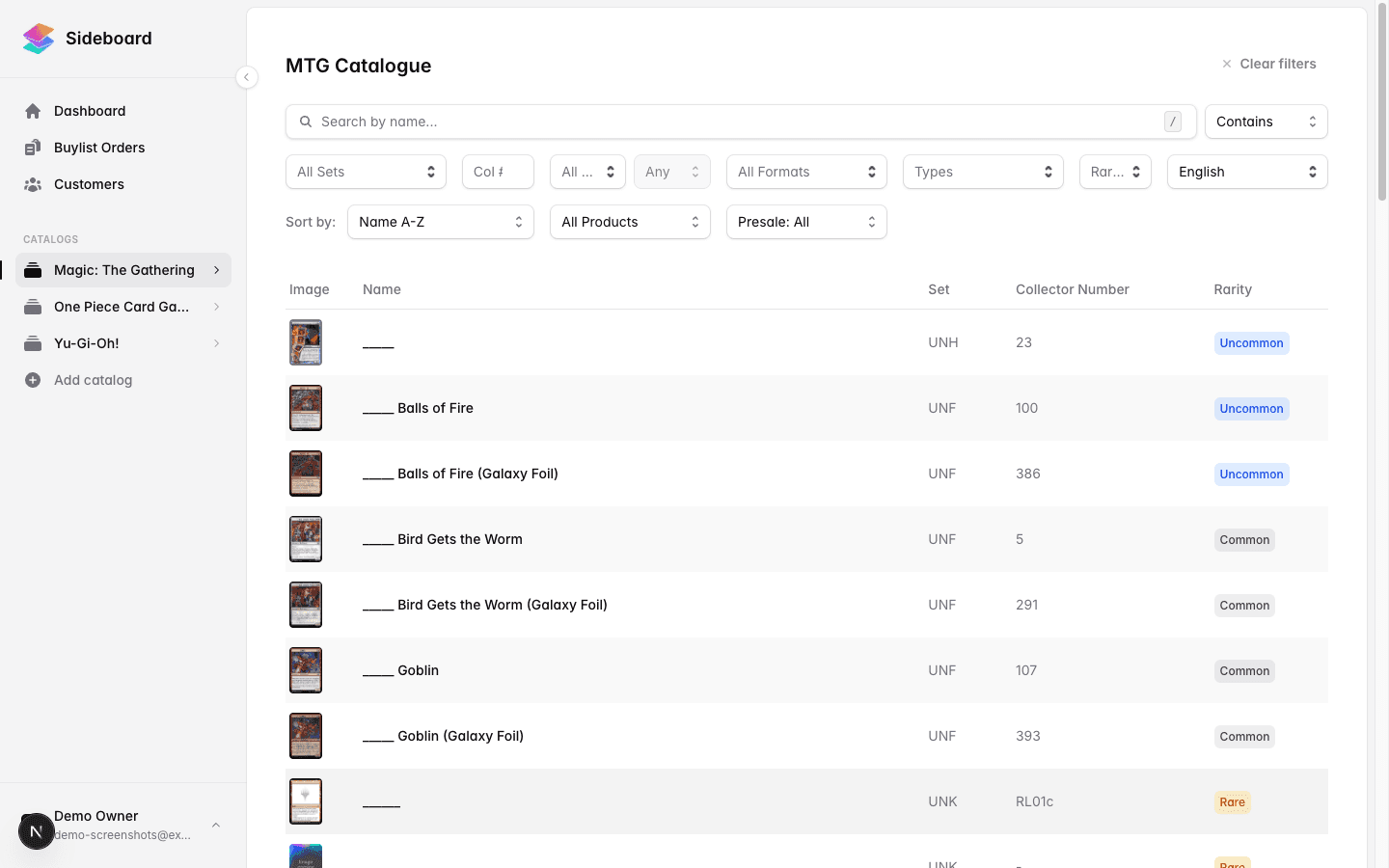
MTG has the deepest catalog of any game on Sideboard — hundreds of sets back to Alpha, multiple parallel product lines (main sets, Commander, Secret Lairs, Universes Beyond, Art Series, promos), nine languages, and the richest variant library of any game. The complexity is handled behind the scenes; what you see is a clean catalog with accurate per-finish pricing.
Sets & Catalog
Sideboard maintains a complete catalog of every TCGPlayer-listed MTG set, including:
- Standard and modern sets — Bloomburrow, Duskmourn, Foundations, and all current sets
- Commander products — preconstructed decks and Commander-specific sets
- Secret Lairs — tracked as their own product type; each drop appears as a distinct set
- Universes Beyond — crossover sets (Lord of the Rings, Assassin’s Creed, Final Fantasy, Fallout, etc.) are cataloged separately, not merged into their thematic era
- Promo packs and prerelease promos — tracked as supplemental sets linked to their parent expansion
- Art Series — cataloged as separate products
- Older sets — the catalog includes sets back to Alpha, though some foreign-market-only prints (Renaissance Italian, Salvat Spanish) are not on TCGPlayer and won’t appear
New sets typically appear in Sideboard’s catalog within 24 hours of TCGPlayer listing them.
One thing to know: Because MTG has so many set variants, not every regional or limited print is covered. MTGO-only sets and some niche promo subsets from TCGPlayer’s back catalog are excluded.
Cards
MTG has the richest variant library of any game on Sideboard. Each unique product is tracked as a distinct entry, so a regular print, a borderless treatment, an etched foil, and a Japanese alternate art for the same card all appear as four separate items in your catalog. This means:
- Showcase and borderless treatments are distinct catalog entries
- Etched foil printings are distinct catalog entries — they’re separate products from the standard print, with their own market price
- Japanese alternate art versions (e.g. Mystical Archive Japanese variants from Strixhaven) appear alongside the English prints — supplemental sets with Japanese alternate-art prints carry far more catalog entries than their English-only counterparts
- Collector Booster exclusives (extended art, alternate frame) are tracked separately
- Prerelease stamped cards appear as their own entries
Rarities
Sideboard uses the canonical 5-tier MTG rarity ladder: Mythic, Rare, Uncommon, Common, and Special (the catch-all bucket for Art Cards, Conspiracy cards, Schemes / Planes, and Mystery Booster test cards). All five appear in the rarity filter and the buylist-rule dropdowns. Sorting by Rarity puts Mythic at the top; Special trails Common because it’s a niche category, not a tier above Mythic.
Card Types
Sideboard recognizes the following MTG card types for filtering and buylist rules:
- Creature, Instant, Sorcery, Enchantment, Artifact
- Planeswalker
- Land (including Basic Lands)
- Battle — introduced in March of the Machine (2023), used by Sieges
- Tribal — a legacy type retained on reprinted cards
Card-type matching uses substring search on the full type line, so a buylist rule with Battle matches Battle — Siege and Battle — Siege // Sorcery. Token cards appear with Token Creature — Bird (or similar) in their type line and aren’t a separate dropdown option — filter via the type-line substring, or see the “Token cards” gotcha below.
Languages
MTG is multilingual on Sideboard. Cards are stored with their printed language, and per-language pricing is tracked when market data supports it. The languages you’ll see most often are English (en), Japanese (ja), Russian (ru), Italian (it), German (de), Spanish (es), Korean (ko), French (fr), and Portuguese (pt); additional languages (e.g. Phyrexian, Simplified Chinese) appear automatically when their printings are imported.
The catalog and rule editors default to all languages. Add a language filter when you want to narrow to specific prints.
Finishes
Sideboard tracks two MTG finishes: Normal (every non-foil print) and Foil (traditional foil treatment). Etched foil printings are separate catalog entries (their own product, their own price) rather than a finish on the regular print — see the “Treatment variants are separate products” gotcha below. The same logic applies to extended-art, borderless, and Japanese-alternate-art treatments.
Card metadata
Sideboard enriches MTG cards with detailed card metadata:
- Oracle text, mana cost, colors, color identity
- Type line and subtypes
- Format legality (Standard, Pioneer, Modern, Legacy, Commander)
- Power/toughness for creatures, loyalty for planeswalkers
This enrichment is available for filtering in the catalog and in buylist rules — you can write rules that target only red cards, only instants, or only cards legal in Pioneer.
Pricing
MTG pricing from Sideboard covers all variant/finish combinations that have real market data:
- Cards in your active inventory refresh prices every 6 hours
- Cards you don’t stock refresh daily
- Prices are tracked per condition (Near Mint through Damaged) and per finish (Normal / Foil)
- Foreign-language prints carry their own per-language pricing when market data is available
See How pricing works for full details on how Sideboard syncs and displays prices.
Note: Very new cards in a just-released set may have limited pricing data for the first day or two after launch, as the market develops. Pricing activates automatically once market data is available.
Common Workflows
Managing a new set release:
- The set appears in your catalog automatically within 24 hours of TCGPlayer listing it
- Pricing populates on the next pricing run after the catalog refresh
- Add singles to inventory via the Catalogue page — search by set name, then add quantities per card and condition
Handling Secret Lairs:
- Each Secret Lair drop is its own set entry, separate from the base set of any reprinted cards
- If you stock a card that exists in both a Secret Lair and a regular set, they appear as separate items with separate prices and inventory counts
Filtering by format in buylists:
- Use the Format legality filter when building buylist rules to buy only cards legal in specific formats (e.g., “buy all Pioneer-legal cards above $5 at 50% market”)
Gotchas
Universes Beyond ≠ the crossover theme. Lord of the Rings cards are in the “Universes Beyond” product type, separate from the main set calendar. If you’re filtering by product type to find “all recent expansion sets,” UB sets won’t appear unless you explicitly include them.
Secret Lair reprints are separate from the original printings. A Thoughtseize from a Secret Lair is a different catalog item than one from Theros or Modern Masters. Prices, inventory, and buylist quantities are tracked independently.
Foreign-market prints. A small number of sets (Renaissance Italian/German, Salvat Spanish encyclopedia, some Chinese tournament exclusives) aren’t on TCGPlayer and don’t appear in Sideboard’s catalog.
Treatment variants and buylist rules. Buylist rules that target a card by name will match every treatment variant (etched, extended art, alternate frame, borderless, Japanese alternate) by default — they’re separate catalog entries with separate market prices but share the same card name. Narrow by set or use the per-product UI when you only want one specific printing.
Token cards have their own card type, not a rarity. Token cards (e.g. “Knight Token | Token Creature — Knight”) are tracked as a card type rather than as a rarity. Filter for them by type (Creature) and the substring “Token” in the type line, not by a rarity dropdown.
Was this page helpful?
Spotted something wrong, or want to suggest an improvement? Email support → — your message goes straight to engineering.